Business Energy Prices – Are they still rising and why?
Every home and business knows that energy prices have risen over the past five years since the global pandemic, with the highest increases occurring in 2021 and 2022. Prices dipped in 2023, but 2024 saw steady energy rate rises. During 2025, prices were relatively stable compared to 2022, although they remained well above pre-pandemic norms. In March 2026, however, wholesale gas and power markets moved sharply higher again after the Iran conflict escalated into direct attacks on major Gulf energy infrastructure.
TL;DR
- Business energy prices remain higher than pre-pandemic levels, even though wholesale markets have eased from the extreme peaks seen during 2021 and 2022.
- UK energy prices have risen because of global supply disruption, higher gas demand, geopolitical conflict, limited gas storage, low renewable output and rising non-commodity costs.
- There is no business energy price cap, so commercial gas and electricity rates are more directly exposed to wholesale market volatility, supplier risk margins and contract timing.
- Gas prices continue to influence electricity prices, because gas-fired generation still plays an important role in setting UK wholesale power prices.
- Fixing a business energy contract can help protect budgets, but it may not suit every organisation if wholesale prices fall or the business has a higher tolerance for market risk.
- Businesses can reduce exposure by reviewing contracts early, avoiding out-of-contract rates, improving energy efficiency, monitoring usage and choosing a procurement strategy that matches their risk profile.
Why have UK energy prices risen?
To understand why prices have risen over the past five years, it’s important to look back at recent events, internal conditions and global factors that influenced energy prices.
Recent Events
2020
- During the lockdown in early 2020, reduced demand caused energy prices to remain low.
- As demand recovered, gas and electricity rates exceeded pre-pandemic levels, while rising policy and regulatory costs, like the Renewable Obligation (RO) levy and network charges, further drove up prices.
2021-2022
- Between August 2021 and August 2022, wholesale prices surged over 500% due to:
- Lockdowns easing and increase demand for energy as businesses and events reopen.
- Global events, including the Ukraine conflict and the closure of Nord Stream and other infrastructure issues
- Over 40% of European gas imports were from Russia in 2021, and the conflict threatens this supply, driving prices up
- Despite the UK only using 5% imports from Russian gas, the wider supply crisis across Europe required the UK to change its gas balancing policy to reduce future risks.
- Extended cold periods increased worldwide gas demand, depleting supplies more rapidly and contributing to higher prices.
- 34 UK energy suppliers went out of business due to being unable to handle the rising wholesale energy prices, which drove up prices even further.
- Prices reached a record high decoupling from market fundamentals
- Countries like China and Japan have increased liquefied natural gas (LNG) imports to reduce coal reliance, limiting the UK’s access to LNG and affecting gas prices.
2023
- Prices then began to fall because Europe shifted from Russian gas to more LNG imports from other suppliers.
- A mild winter across the UK and Europe, and energy-saving efforts being made by homes and businesses because of the fear of high energy bills, helped to reduce demand and resulted in a drop in price.
- A fire on the national grid infrastructure in Kent disrupted a major power line from France, curtailing electricity imports until 2023.
2024-2025
- 2024 and much of 2025 were a period of market correction, as a new stable market price was established at £80/mwh
- Ongoing conflict in the Middle East created uncertainty in global oil and gas markets. Disruptions to shipping routes, especially in the Red Sea, increased transport costs for LNG and oil, which fed into UK wholesale prices.
- Political uncertainty following the 2024 US election, including concerns over potential changes to US LNG export policy, influenced market confidence.
- Stronger global demand for LNG, particularly from Asia, reduced the availability of flexible cargoes for Europe, pushing up gas prices at certain points.
2026
- The Iran conflict has escalated from a geopolitical risk into a direct threat to gas and LNG supply. Recent attacks on Iran’s South Pars gas field and retaliatory strikes on Gulf energy infrastructure, including Qatar’s Ras Laffan LNG hub, have pushed oil and gas markets sharply higher. This matters because Britain remains exposed to international gas pricing. When wholesale gas prices rise, business gas rates can increase directly, and business electricity prices can also rise because gas-fired generation still plays a major role in setting the marginal price of power in the UK.
Internal Conditions
Low Gas reserves
The UK cannot stockpile any excess gas for when it may be needed due to limited storage options. In fact, the UK has some of the lowest gas reserves in Europe as its capacity of reserves are around 2% of annual gas demand. The average reserves of European countries are 25% and 37% for the largest reserves.
Reduced Renewable Output
Low wind activity and nuclear outages result in less renewable energy being generated. This results in a higher amount of gas being used to generate electricity, which increases costs. Even green tariffs increase in price because renewable energy prices are linked to the price of gas.
Limited Financial Support
Previous financial support for business from the Government has ended, and a price cap system does not exist at present. Whereas in comparison to other European countries, France for example, capped electricity price increased to 4%.
No Energy Price Cap for Businesses
Unlike households with a price cap, UK businesses lack this protection. Recent government support included discount schemes like the Energy Bills Discount Scheme, which ended on March 31, 2024. Future support is still uncertain, and businesses should stay informed about potential government policy changes that could impact energy prices.
As there is no price cap on business energy, energy rates vary with wholesale market conditions, which can be volatile and difficult to predict. Although the domestic price cap does not apply to businesses, it can still act as a useful indicator of the direction of wholesale costs. In March 2026, Cornwall Insight forecast the household cap would rise about 11% in July because wholesale gas prices had risen more than 60% in two weeks, underlining the renewed pressure in the wider market that businesses are exposed to directly.
Non-Commodity costs
Including network charges and policy-related costs, overall electricity rates continued to increase even as wholesale prices stabilised. This remains a major issue for UK businesses. Even when wholesale markets ease, non-commodity costs such as network charges, balancing costs and policy-related levies can keep electricity bills elevated. Ofgem said in January 2026 that GB electricity prices were 92% higher for medium-sized businesses than the EU median, showing that UK firms are dealing with structurally high electricity costs as well as short-term wholesale volatility.
Global Factors
Oil prices
Oil prices aren’t as influential to the UK’s energy generation as they are to other countries, but they still have a knock-on effect. Due to OPEC production cuts or conflicts in the Middle East, oil prices rise. Transport and supply chain costs increase as well, where gas prices are linked to oil; both costs will rise together.
Global gas prices
The UK is a large importer of gas, especially LNG from the US, Qatar and Norway. When these supplies are disrupted by wars, sanctions or extreme weather, prices will increase due to less supply. As gas powers electricity generation, higher gas prices have a knock-on effect of higher electricity prices.
Forex Exchange Rates
The forex and currency exchange rates influence energy prices because energy is priced globally in US dollars. Whenever there are changes to either the strength of the US dollar or the UK pound, it will cost more or perhaps be cheaper to import gas and oil.
Extreme Weather
Severe weather and disasters can damage energy-generating sites or infrastructure to transfer energy, once again affecting supply. Abnormal weather conditions can increase demand, so a prolonged cold spell would use up UK gas reserves and therefore force prices to increase.
Are energy prices still rising?
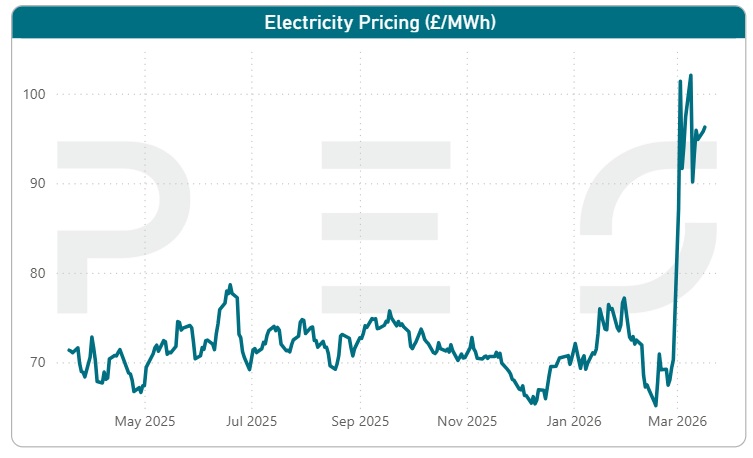
Yes, and the market has become more volatile again in March 2026. Although wholesale prices were more stable through much of 2025 than during the extreme swings of 2022, recent escalation in the Iran conflict has pushed gas and power markets sharply higher again.
For businesses, this matters immediately because there is no business energy price cap. Contract prices are influenced by wholesale costs, supplier risk margins and non-commodity charges, so even where wholesale markets later ease, overall business energy prices can still remain elevated.
The charts below show that while wholesale prices had eased from their 2022 peak, recent conflict-driven disruption has ended the period of relative calm that many businesses had hoped for in 2026.
Should I fix my business energy contract?
Yes and no. Currently, prices are much higher than before the 2022 price spike, and without a cap on business energy, it means prices could rise without any government intervention. Therefore, it could be worthwhile agreeing to a fixed-price energy contract to lock into a more favourable rate in case of any further price increases, especially as it is not expected that prices will drop to pre-pandemic levels again. Fixing can also provide stability in a volatile market and help with financial predictability at a time when long-term prices are still projected to remain high. In addition, you avoid being placed on a supplier out-of-contract rate, which can be as much as 35% higher than fixed contracts.
However, you still need to consider your attitude to risk. Once fixed in, business contracts are traditionally at least two years in length, and you never know if there could be a drop in price. A fixed-rate contract can protect you if prices rise further, but it also means you will not benefit if wholesale markets fall, especially if the conflict ends and prices fall.
In the current market, fixing may be less about trying to beat the market and more about protecting budgets and margin certainty. For some businesses, that will make sense. For others, a more flexible or staged purchasing strategy may be better if they can tolerate short-term volatility. The right decision depends on usage profile, renewal timing and how much risk the business can absorb.
Will energy prices go back to pre-pandemic levels?
Despite the wholesale prices having fallen, the price of energy is still high, and it’s predicted that it won’t return to pre-pandemic levels this decade. This is because wholesale price drops are not passed on to the customers due to several factors:
- Energy suppliers buy energy in advance to offer fixed rates. If they previously bought energy at higher prices, they can’t immediately lower what customers pay just because today’s wholesale price has dropped.
- Suppliers build risk into their pricing, much like lenders do with interest rates. This protects them from sudden market changes and unexpected costs.
- Suppliers constantly buy energy to meet demand. If demand suddenly rises, they may need to buy more energy at current (potentially higher) prices. If demand falls and they have excess energy, they must sell it back to the grid—sometimes at a loss if the market price is lower than what they originally paid.
- In a volatile market, suppliers face higher financial risk, so prices stay higher for longer. Only when wholesale prices stay lower for a consistent period do those reductions typically make their way to customers.
Why are energy prices volatile?
Energy prices respond to market supply and demand, which causes their price to fluctuate. Low supply raises prices; high supply reduces them. Increased demand pushes rates up, while lower demand brings them down. Market confidence also plays a part, as traders react quickly to news about potential shortages or political risks, which can cause prices to jump even before any real disruption occurs.
Supply chain issues can also increase volatility. Less supply will result in higher prices, and supply can be influenced by many of the factors already mentioned, including pandemics, shipping delays, global crises and weather events. Even rumours of disruption can push prices up, as uncertainty in international energy markets is often priced in immediately. This behaviour filters through to the UK’s wholesale market and contributes to sudden price movements for businesses.
How do energy suppliers handle price volatility?
To manage risk, suppliers often use futures markets to lock in fixed prices for future energy needs. This means they buy or sell a set amount of energy at an agreed price and then settle the contract at a future date. In periods of extreme unpredictability, such as the 2022 price spike, this approach became far more difficult, and some suppliers temporarily withdrew from providing prices due to the heightened risks of short supply.
Why are electricity prices higher than gas prices?
UK electricity prices are also closely tied to gas costs because a significant proportion of electricity is generated from gas-fired power stations. When gas prices increase, electricity costs typically rise as well, making volatility more challenging for businesses to plan around.
This volatility affects gas and electricity differently, and there are several reasons why electricity prices tend to be higher than gas prices:
- Electricity generation is more complex. Producing electricity requires extensive infrastructure, multiple conversion processes and ongoing operational management, all of which make it more expensive to generate and distribute compared to gas. Gas extraction and distribution are more straightforward, leading to lower overall costs.
- Environmental and policy levies increase costs. Electricity bills often include additional charges to support renewable energy, carbon reduction schemes and wider environmental policies. These levies are applied far less frequently to gas, creating a natural price difference between the two.
- Greater investment in the electrical grid. Maintaining and upgrading the electricity network requires significant long-term investment. These costs are passed through to consumers. In contrast, gas infrastructure tends to require less frequent and less costly upgrades, helping keep gas prices comparatively lower.
Ofgem’s January 2026 market report reinforces the point that the UK’s electricity prices remain among Europe’s highest, and medium-sized businesses pay around 92% more than the EU median.
Why are renewable energy prices also rising?
Even on 100% renewable energy plans, prices have surged. This stems from the UK’s marginal cost pricing model, where the costliest energy source sets the price for all, meaning gas-fired power often influences renewable rates, irrespective of the lower operational costs associated with renewables. The government is considering a shift to a Contracts for Difference (CfD) approach. Under CfD, renewable and nuclear producers receive a fixed price, uncoupling a high percentage of renewables in the UK’s energy mix from gas costs, which could stabilise prices for those opting for clean energy. This is one reason businesses can still feel the impact of a gas price increases even when buying renewable-backed electricity. If gas remains the marginal source of power, wholesale electricity prices can still rise across the market when international gas prices surge.
Which businesses are most exposed to rising energy prices?
The effect of rising energy prices is not the same for every business. Manufacturers, engineering firms, food producers, hospitality sites, leisure venues and multi-site operators tend to feel the impact more quickly because energy is a larger share of their operating costs. Businesses that are close to contract renewal are also more exposed, because they may need to secure new rates during periods of market volatility. Recent reporting has already shown the effect on energy-intensive sectors in the UK and Europe, with some manufacturers facing sharp month-on-month increases in gas costs.
Options if you cannot afford your energy bills
If your business is struggling to cover energy costs, promptly contacting your supplier to discuss a payment plan is essential. Without an agreed plan, suppliers may initiate disconnection procedures after 30 days of missed payments. Seeking guidance early can help prevent service interruptions and provide alternative options for managing arrears. It’s also important to look at ways to reduce your consumption through an energy audit; once you understand your usage, you are in a better position to find energy deals that may help you save. In addition, make sure you know when your contract renewal date is so that you can potentially look for a more competitive deal before being locked into an auto-renewed contract.
Choose the right energy contract
At Professional Energy Services, we help businesses select the best energy contracts based on their consumption, forecast and attitude to risk. Our business energy consultants have helped countless businesses save thousands on their energy costs by working alongside our clients and helping them to navigate the complex and volatile energy market. Speak to a member of our team and see how you could start saving today.