DUoS and TNUoS Charges Explained
Business electricity bills can be difficult to interpret, especially when the final cost is influenced by more than the unit rate or standing charge. For many organisations, charges linked to network use, peak demand and regional pricing have an impact on their overall electricity spend.
In this guide, we focus on the non-commodity charges of Distribution Use of System (DUoS) and Transmission Network Use of System (TNUoS) charges from a business perspective, including where they appear on bills, what affects them, and how businesses can manage their impact more effectively.
TL;DR:
- DUoS and TNUoS are non-commodity electricity charges that appear on business energy bills and relate to the cost of using the UK’s electricity networks.
- DUoS charges are linked to the local distribution network, which delivers electricity from the grid to business premises.
- TNUoS charges are linked to the national transmission network, which moves electricity from generators and power stations across the UK.
- The amount a business pays can depend on location, agreed capacity, peak-time usage, reactive power and half-hourly consumption data.
- Businesses may be able to reduce these costs by monitoring usage, shifting demand away from peak periods, reviewing capacity and improving energy efficiency.
- Understanding DUoS and TNUoS charges can help identify billing issues, avoid unnecessary costs and improve energy cost management.
What is DUoS?
DUoS stands for ‘Distribution Use of System’ and are charges you will see on your electricity bill which are imposed by DNOs and Independent DNOs for using the local electricity distribution network. These charges cover the costs of maintaining, upgrading, and operating the infrastructure required to deliver electricity from the transmission network to end consumers.
How are DUoS charges calculated?
DUoS charges are based on multiple factors, including your share of demand on the transmission network. This charge is comprised of several components:
- Availability Charge: Also known as KVA or Agreed Supply Capacity (ASC) charge, this is the fee for the power capacity held available for a supply point, charged daily in £/kVa.
- Excess Availability Charge: Applied if the Agreed Supply Capacity is exceeded. Ensuring your kVA is correctly set can prevent unnecessary costs.
- Reactive Power Charge: For non-working power used by equipment like motors and transformers, charged if it exceeds DNO limits. Installing Power Factor Correction equipment can mitigate these costs.
- Daily/Standing Charge: A fixed fee set by your supplier to cover the costs of distributing and supplying energy, as well as maintaining the infrastructure.
- Unit Rates: Charges based on consumption, divided into Red (peak), Amber (daytime), and Green (off-peak) time bands, varying by region and supplier. The following common time bands used are:
- Red– 16.00-19.00 Monday-Friday (peak)
- Amber–07.00-16.00 then 19.00-22.00 Monday-Friday, 16.00-19.00 Saturday-Sunday (daytime)
- Green – 00.00-07.00 then 16.00-19.00 Monday-Friday, 00.00-16.00 then 19.00-0.00 Saturday-Sunday (off-peak)
The example below shows the DUoS charge bands for the London Power Network Area
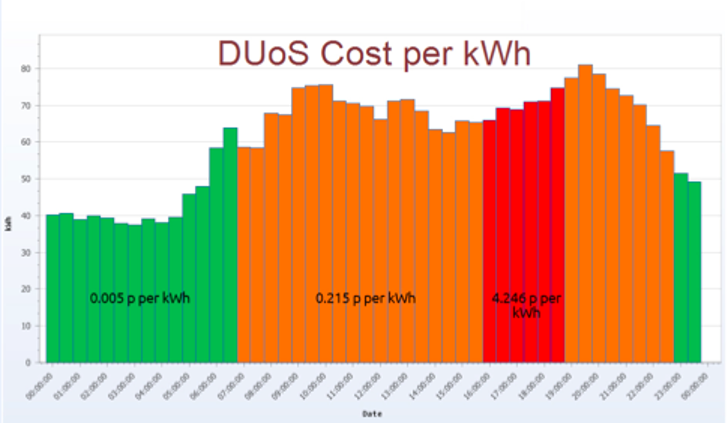
Peak times incur higher rates to manage demand and encourage off-peak usage. These charges ensure the network remains reliable and efficient for all users. Each Network Operator has different rates, and the cost varies with the time of usage.
In addition, each Distribution Network Operator (DNO) sets the rates for their region, reflecting the local infrastructure and maintenance costs. The goal is to distribute the expenses fairly among users while ensuring network reliability. To determine applicable rates, find the ‘Line Loss Factor’ (LLF) for your site, which can be located by the last three digits of your electricity supply’s Meter Point Administration Number (MPAN). The MPAN, a 13-digit unique
DNOs are regulated by OFGEM, (Office of Gas and Electricity Markets) to ensure that consumers receive reliable and fairly priced energy services.
What is TNUoS?
TNUoS stands for (Transmission Network Use of System) and is a charge on your energy bill imposed by the transmission network to help cover their costs of maintaining and operating the high-voltage transmission network that transports electricity from power stations to local distribution networks.
These charges are applied to both generators and consumers, ensuring that the infrastructure remains robust and capable of meeting national electricity demands.
How are TNUoS charges calculated?
Each year in March, National Grid selects the three half-hour periods with the highest demand from the previous November to February. An average of your usage during these periods, known as the Triad, is calculated. This figure is doubled to reflect a full hour’s usage and then multiplied by the relevant regional TNUoS rate to determine the final annual charge. If energy is used strategically during the Triad period, you will be able to lower TNUoS your charge.
Recently, TNUoS charges have increased due to higher transmission network costs. This rise is driven by the need to upgrade ageing infrastructure and accommodate more renewable energy generation.
High Voltage Assets
High voltage assets refer to the equipment and infrastructure used in the transmission of electricity at high voltages, including transformers, substations, and high-voltage power lines.
Businesses connected to high-voltage networks might be subject to the Extra-high Voltage Distribution Charging Methodology (EDCM). The EDCM is used to calculate DUoS charges for large users connected to the distribution network at higher voltages.
These charges consider the specific costs associated with maintaining and operating the high-voltage infrastructure and can vary significantly based on location and usage patterns.
Impact of DUoS and TNUoS Charges on Businesses
DUoS and TNUoS charges significantly influence a business’s operational costs. These non-commodity charges can make up a substantial portion of the total electricity bill. High charges during peak periods can increase costs, impacting businesses’ profitability.
It is important for businesses to understand and manage these charges to optimise their energy expenses.
By strategically managing their energy use, businesses can reduce these charges, resulting in lower overall energy costs and improved financial performance.
How can Businesses Reduce DUoS and TNUoS Charges?
As mentioned above, if you are able to reduce your DUoS or TNUoS charges you are able to lower a proportion of your business energy costs. To reduce these charges it is key to ensure you are tracking your energy consumption, as you can then track your DNUoS and TNUoS charges. To do this you’ll need to have an energy management system and monitoring tools in place that have real time usage data, and the ability to forecast and predict future changes based on historical usage. With tracking in place, you can reduce your charges in the following ways:
Reducing DUoS Charges:
- Shift Operations: Move high-energy activities to off-peak periods to take advantage of lower green band rates.
- Energy Audits: Regularly conduct energy audits to identify inefficiencies and opportunities for savings.
- Energy Efficiency: Implement energy-saving measures and technologies to reduce overall consumption based on your energy audit.
- Load Management: Use energy management systems to monitor and adjust usage patterns effectively.
- Flexible Contracts: Negotiate flexible energy contracts that allow for adjustments based on changing consumption patterns.
- Renewable Integration: Incorporate renewable energy sources to reduce dependency on the grid during peak times.
- Employee Training: Educate employees about energy-saving practices and the importance of efficient energy use. Implementing these best practices can help businesses reduce costs and improve energy efficiency.
- Capacity Planning and reviews: Optimise and review the contracted capacity and the amount you use to avoid excess charges. If you are using less you may be able to agree a lower capacity allowance with your supplier.
Reducing TNUoS Charges:
- Location Optimisation: Consider the impact of location on charges and adjust operations if possible.
- Demand Response: Participate in demand response programs to manage and reduce peak load contributions.
What is BSC Modification P272?
BSC Modification P272 is a regulation, implemented on April 1, 2017, that mandates the way electricity suppliers calculate electricity consumption for businesses within a specific energy use, defined as profile classes 5-8, and results in sites being moved from non-half-hourly energy meter (NHH) to half-hourly metering (HH).
This change introduced a new way for businesses to be charged for DUoS and TNUoS, affecting the cost of these charges and the amounts businesses pay on their electricity bills. As a result, some businesses will experience an increase in charges, while others may see a decrease.
This change aims to improve billing accuracy and encourage efficient energy use by basing DUoS and TNUoS charges on actual half-hourly consumption data rather than estimates. The modification helps businesses gain a clearer understanding of their energy usage patterns, allowing for better management and optimisation of electricity costs. This regulatory change highlights the importance of accurate data in energy management.
Government Incentives and Support
The UK government announced the British Industry Supercharger (BIS) on the 23rd February 2023, a set of measures to make Britain’s strategic Energy Intensive Industries (EIIs) more competitive across Europe. Part of these measures include the EII Network Charging Compensation (NCC) Scheme, which will permit eligible energy-intensive users to recover 60% of eligible network charging costs, including TNUoS and DUoS. Pending the necessary legislation, the scheme is expected to launch in April 2025, with support for EIIs backdated to April 1, 2024.
Future Trends in Energy Charges
As the energy landscape evolves, several trends are likely to impact DUoS and TNUoS charges. Increased integration of renewable energy sources, advancements in smart grid technology, and evolving regulatory frameworks will shape future pricing structures.
Businesses can expect more dynamic pricing models, reflecting real-time grid conditions and incentivising demand-side management. Staying informed about these trends and adopting flexible, adaptive energy strategies will be crucial.
How an Energy Consultant can Help
When managing DUoS and TNUoS charges, businesses often make common mistakes such as neglecting to monitor usage patterns, failing to shift operations to off-peak times, and overlooking the benefits of energy management systems. Another frequent error is not optimising contracted capacity, which can lead to excess charges. Businesses may miss out on available government incentives and support programs. By working with a specialist energy consultant such as Professional Energy Services, we can support you by helping you avoid these mistakes that can result in significant cost savings and more efficient energy use. Contact us today to speak to a member of our team.