Non-Commodity Charges Explained – What UK Businesses Need to Know
Non-commodity charges can be one of the harder parts of a business energy bill to understand. They sit alongside the wholesale cost of gas and electricity, but they are often less visible and harder to compare between contracts. The total energy costs for a business won’t be driven by wholesale energy prices alone due to these additional non-commodity costs. This guide explains what non-commodity charges are, why businesses pay them, what can influence their price and what to check before agreeing your next business energy contract.
TL;DR
- Non-commodity charges are the non-wholesale costs on a business energy bill, including network, system, policy, tax, metering and settlement costs.
- They can be bundled into unit rates, standing charges or pass-through costs, making contracts harder to compare.
- The price can vary by region, meter type, capacity, usage profile, supply type, contract structure and relief eligibility.
- Electricity and gas have different non-commodity cost structures, with electricity typically carrying a wider range of network and policy charges.
- Businesses should check how charges are applied before signing a contract, validate bills regularly and confirm whether any exemptions or reliefs apply.
What are non-commodity charges?
Non-commodity charges are the parts of a business energy bill that are not the wholesale cost of the gas or electricity itself. They are also often described as third-party charges, pass-through costs or non-energy costs.
These charges cover the wider costs involved in delivering energy to a business site and supporting the UK energy system. That can include electricity transmission, local distribution, system balancing, metering, data collection, environmental schemes, energy policy costs and taxes.
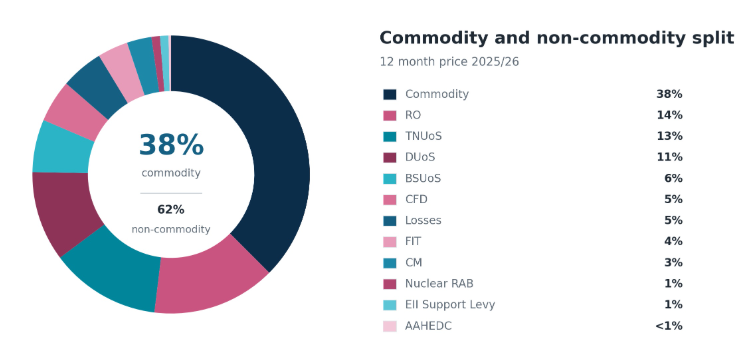
This means your energy bill is made up of more than the price of the energy you consume. For electricity, non-commodity charges can make up a large share of the total business energy bill, with some market estimates placing them at around 60% or more of business electricity costs. Even if wholesale prices fall, non-commodity charges can still have a significant effect on the final amount you pay.
Commodity vs non-commodity charges: what is the difference?
Commodity charges relate to the energy your business uses. They are linked to the wholesale cost of buying gas or electricity and are usually measured against consumption in kilowatt hours, or kWh.
Non-commodity charges sit around that core energy cost. They help recover the costs of transporting energy, maintaining networks, balancing supply and demand, supporting low-carbon generation and funding policy mechanisms.
This distinction matters when comparing business energy contracts. A quote with a competitive headline unit rate may still carry different non-commodity exposure, particularly if some costs are passed through or reconciled later. Looking only at the commodity price can make one contract appear cheaper than it may be in practice.
Why do businesses have to pay non-commodity charges?
Businesses pay non-commodity charges because the energy system has costs beyond buying fuel or power in the wholesale market. Electricity and gas need to be transported, networks need to be maintained, supply and demand need to be balanced, meters and settlement processes need to be operated, and policy schemes need to be funded.
Many of these costs are not set by the supplier. They may be set by network operators, government schemes, regulators or market bodies. The supplier often collects them through the customer’s bill and passes the money on to the relevant organisation.
This is why non-commodity charges are often described as pass-through costs. The supplier may bill the customer, but the charge itself usually reflects wider system, regulatory or policy requirements rather than the supplier’s own margin.
For business customers, the important point is that these charges are not all doing the same job. Some relate to moving energy through transmission and distribution networks, some relate to balancing supply and demand, some support security of supply, and others fund environmental, tax or policy schemes. Understanding that distinction helps when reviewing bills or asking suppliers what is included in a contract.
What electricity network and system charges can appear on business bills?
Electricity bills can include several network and system charges. The exact treatment depends on the contract, supplier and site profile, but common electricity-related non-commodity charges include:
- Transmission Network Use of System (TNUoS): contributes to the cost of the national electricity transmission network. Depending on the site and contract, costs may be recovered through standing carges, site specific charging methods of supplier pricing.
- Distribution Use of System (DUoS): covers the local distribution networks that move electricity from the wider grid to business premises.
- Balancing Services Use of System (BSUoS): helps recover the cost of balancing electricity supply and demand in real time.
- Capacity Market charges: support mechanisms intended to maintain security of electricity supply during peak demand periods. Costs can be linked to a peak demand periods, including winter weekday peak windows where relevant.
- Assistance for Areas with High Electricity Distribution Costs (AAHEDC): supports areas where electricity distribution costs are higher.
- Elexon and settlement-related charges: relate to the cost of operating electricity market settlement processes. Elexon administers aspects of the Balancing and Settlement Code, which underpins how electricity volumes are reconciled between suppliers, generators and market participants.
- Imbalance-related costs: suppliers can face costs when the electricity they buy does not match the electricity their customers use. These risks may be reflected in contract pricing, especially where consumption is harder to forecast.
- Metering and data charges: cover meter operation, maintenance, reading and, where relevant, half-hourly data collection.
What environmental and policy charges can appear on business energy bills?
Environmental and policy charges support government schemes, low-carbon generation, energy efficiency objectives or wider policy costs. These charges are often grouped with non-commodity costs because they sit outside the wholesale energy price.
Common examples include:
- Renewables Obligation (RO): a scheme designed to support renewable electricity generation. Although closed to new capacity, it continues to support existing accredited generation, with suppliers recovering the cost through customer bills.
- Feed-in Tariff (FiT): a legacy scheme supporting small-scale low-carbon generation. Although closed to new capacity, existing commitments can still be recovered through bills.
- Contracts for Difference (CfD): a mechanism that supports low-carbon electricity generation by stabilising revenues for eligible generators. In simple terms, generators may receive a top-up when wholesale prices are below an agreed strike price and pay back when prices rise above it.
- Climate Change Levy (CCL): a tax on business energy use, intended to encourage energy efficiency and lower emissions. The amount a business pays can be influenced by how much taxable energy it uses and whether any valid relief applies.
- Renewable Energy Guarantees of Origin (REGO): certificates issued for eligible renewable electricity generation and used by suppliers as part of fuel mix disclosure. One REGO certificate represents one megawatt hour of eligible renewable output.
- Nuclear Regulated Asset Base (Nuclear RAB): a levy linked to funding new nuclear infrastructure, including projects developed under the regulated asset base model.
- Green Gas Levy: a gas-related levy used to support green gas production, including biomethane supported through the Green Gas Support Scheme.
- Energy Intensive Industries (EII) Support Levy: a policy-related charge used to help fund support for qualifying energy-intensive businesses, including compensation linked to some network charges.
What gas non-commodity charges can businesses pay?
Gas bills can also include non-commodity charges, although these are often discussed in less detail than electricity charges. Gas non-commodity costs usually relate to transporting gas through the national and local networks, maintaining capacity in the system, recovering network-related costs and accounting for gas that cannot be fully allocated through settlement.
Common gas-related non-commodity charges include:
- National Transmission System (NTS) charges: charges linked to moving gas through the UK’s high-pressure national transmission network before it reaches local distribution zones.
- Gas Distribution Network (DN) charges: charges linked to the local gas distribution network, which can vary by location, network area and consumption profile.
- Local Distribution Zone (LDZ) System Capacity Charge: a charge linked to maintaining capacity in the local gas distribution network so gas can be supplied when demand is high.
- Local Distribution Zone (LDZ) Customer Charge: a distribution network charge linked to the cost of serving and maintaining gas supply points within a local area.
- Local Distribution Zone (LDZ) Exit Capacity NTS Charges: charges linked to capacity where gas exits the National Transmission System and moves into local distribution zones.
- Distribution Network (DN) Entry Commodity Charge: a charge related to gas entering the distribution network.
- Unidentified Gas (UIG/UID): a charge used to recover the cost of gas that enters the network but is not fully matched to metered consumption. This can happen because of meter reading delays, data errors, losses, theft or meter issues.
What factors influence the price of non-commodity charges
Non-commodity charges are not the same for every business. The cost can be influenced by the site, the supply type, the meter, the contract and the wider policy environment.
Important factors can include:
- Region: network charges vary across different electricity and gas distribution areas.
- Site type and voltage: larger or higher-voltage electricity sites may face different charging structures.
- Meter type: half-hourly and non-half-hourly meters may be treated differently.
- Capacity: agreed capacity, supply point capacity or peak demand can affect certain charges.
- Consumption profile: when and how a site uses energy can influence exposure.
- Time of use: some charges are linked to peak periods or tariff bands.
- Supply type: electricity and gas have different non-commodity cost structures.
- Supply point and network arrangements: gas and electricity costs can also be influenced by the characteristics of the supply point and how the site connects into the relevant network.
- Contract structure: charges may be fixed, passed through, reconciled or adjusted during the contract.
- Policy exposure: eligibility for reliefs, exemptions or sector-specific schemes can change what a business pays.
This is why two businesses with similar annual consumption can still have different total energy costs. Usage volume matters, but it is not the only factor.
How do non-commodity charges appear on bills and contracts?
Non-commodity charges are not always easy to see. They may be bundled into unit rates, included in standing charges, shown as separate line items or recovered through specific contract mechanisms.
Some contracts fix certain non-commodity elements for the duration of the agreement. Others pass charges through at actual cost, meaning the customer pays the amount recovered by the supplier. Some charges may also be reconciled later, which can create adjustments after the initial invoice period. Different charges can also be calculated against different consumption, settlement or network charging bases, so they may not always align neatly with a simple meter read.
It’s also worth bearing in mind that depending on the terms agreed, non-commodity charges can change during a contract. This can happen because many of these costs are set outside the supplier’s control and may be updated by regulators, network operators, government schemes or market bodies. Some suppliers may include clauses that allow charges to be adjusted, reopened or passed through if the underlying cost changes.
This is one reason invoice validation can be complex, especially where costs are linked to network zones, settlement data, peak periods, capacity or supplier reconciliation. Businesses reviewing contracts should ask not only ‘what is the rate?’ but also ‘which charges are fixed, which are pass-through and which can be reconciled?’
Why are non-commodity charges increasing?
Non-commodity charges can increase for several reasons such as network investment, decarbonisation, system balancing, security of supply and new policy mechanisms as key drivers.
The UK energy system is changing. More renewable and low-carbon generation needs to be connected, electricity networks require investment, and the system needs tools to manage supply and demand. At the same time, schemes that support renewable generation, energy security or new infrastructure can add further policy costs to bills.
This does not mean every charge increases in the same way or at the same time. Some charges are linked to network price controls, some to government schemes, some to market conditions and some to supplier recovery methods. For businesses, the risk is that non-commodity movements can offset savings made when wholesale prices fall.
How do non-commodity charges affect business energy costs?
Non-commodity charges affect business energy costs in three main ways.
- They increase the total amount a business pays beyond the wholesale energy price. This can make bills harder to interpret, particularly when the business has focused mainly on unit rates.
- They make contract comparison more difficult. Two quotes may look similar at headline level but treat third-party charges differently. One may include more costs in the fixed rate, while another may leave more exposure to pass-through or reconciliation.
- They affect budgeting and procurement decisions. A business that understands its non-commodity exposure is better placed to challenge unexpected increases, compare contracts fairly and plan for future cost changes.
This is especially important for energy-intensive businesses, where even relatively small changes in non-commodity charges can affect margins and competitiveness.
Which businesses may qualify for exemptions or relief?
Some businesses may qualify for exemptions, discounts or relief from certain charges, but eligibility depends on the scheme, sector, usage and activity.
Energy-intensive industries may be eligible for support linked to specific non-commodity charges. Climate Change Agreements (CCAs) can also reduce CCL exposure for eligible businesses that meet agreed energy efficiency or carbon reduction requirements. Some charitable or non-business uses may qualify for CCL treatment depending on the circumstances.
Not every business should necessarily pay every charge in the same way. Eligibility should be checked at site and account level, and evidence may be needed to support any relief or exemption. Incorrectly applied charges can lead to overpayment, while unsupported claims can create compliance risk.
How can businesses manage non-commodity charges?
Is it possible for businesses to manage non-commodity charges more effectively. Understand which charges are included in the contract, how they are billed and whether they are fixed, passed through or reconciled. Then energy bill validation becomes important, businesses should check whether their charges match the contract, whether reliefs or exemptions have been applied correctly, and whether metering or consumption data looks accurate.
Consumption data can also support better decisions. Smart meters, half-hourly data and usage reviews can help businesses reduce reliance on estimated billing, understand when energy is being used and assess whether operational changes could reduce exposure to time-sensitive costs. This does not remove every charge, but it can improve forecasting and support more informed procurement.
Practical actions include:
- reviewing contract terms before signing;
- checking whether third-party charges are fixed or pass-through;
- validating invoices against agreed terms;
- confirming eligibility for any reliefs or exemptions;
- reviewing usage patterns and peak demand;
- using accurate metering data where available.
What should businesses check before their next energy contract?
Before agreeing a business energy contract, it is worth looking beyond the headline unit rate. Non-commodity charges can materially affect total cost, so the contract should be reviewed for how those charges are treated.
A useful review should focus on three areas: what is included in the quoted rate, which charges can change during the contract, and whether the site data, relief eligibility and usage profile have been checked. This keeps the comparison focused on total cost rather than the headline unit rate alone.
The aim is not to remove every non-commodity charge. Many are unavoidable parts of the energy system. The aim is to understand exposure, avoid incorrect billing and compare contracts on a like-for-like basis.
Professional Energy Services helps businesses make sense of complex energy costs, including non-commodity charges, contract structures, invoice validation and procurement strategy. If you are reviewing a renewal, comparing supplier quotes or unsure whether your business is paying the right charges, our energy consultants can help you assess your options and make a more informed decision.